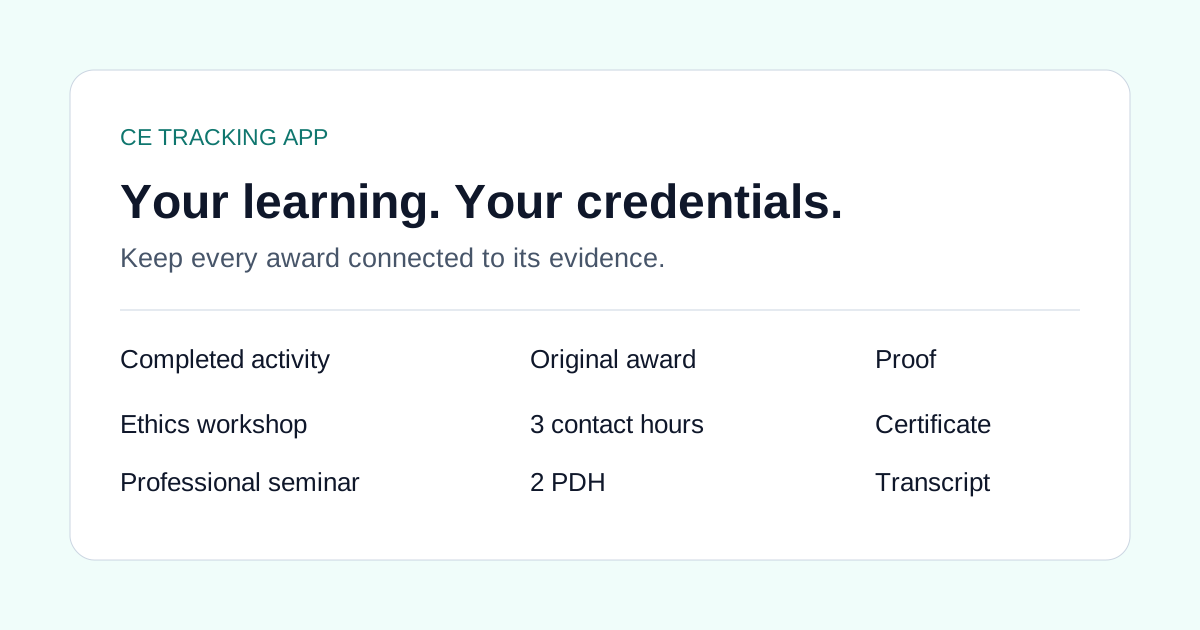
An accountant's transcript says 3 CPE credits. An engineer's certificate says 2 PDH. A project professional has a 1 PDU record. Those numbers can belong in one archive, but a shared column called “hours” should not erase their meaning.
A profession-neutral learning ledger preserves the original award and its evidence. Your credential's rules determine whether and how it counts toward renewal.
Record three facts independently
The reported award is the quantity and unit printed by the provider. Learning duration is the documented time spent learning, when known. Credential credit is what you apply after reviewing the destination's rules.
Those facts may be related, but they are not interchangeable. NASBA's explanation of CPE measurement uses a 50-minute basis and delivery-specific increments. That is a reason to retain a CPE award rather than assume its number describes elapsed clock hours. NASBA guidance.
NCEES's CPC guidance discusses differing jurisdiction rules and recordkeeping for engineers. Its model guidance is not a replacement for the rules adopted by your state board. NCEES guidance.
Four familiar situations
| Profession | A recordkeeping problem | A useful next step |
|---|---|---|
| Accountant | Employer and association transcripts overlap | Preserve the CPE award, provider and completion date; inspect duplicates |
| Attorney | A certificate identifies more than one credit category | Retain the total award and category evidence without summing overlapping components |
| Engineer | One course may support several state renewals | Review each board and period independently |
| Project or HR professional | Certification units differ from another license's units | Keep the named unit and the certifier's supporting documentation |
Use these examples to organize your records, then check the requirements for your own credential.
Use the source's terminology
The import flow supports contact hours, clock hours, CME, CLE, CPE, CPD, PDH, PDU, CEU, academic credits and other named units. If your certificate has a more specific designation, retain that wording with the original evidence and review fields.
For academic work, keep the institution's semester or quarter-credit designation. For courses offering multiple incompatible awards, do not choose a combined quantity by adding them together. Review the source and the award you intend to record.
A record can be useful before eligibility is resolved
You can save a positive award quantity without inventing learning duration. In the shared application, native non-hour awards do not automatically populate recorded learning hours or enter hour-based matching. They remain records you can retrieve and review.
This is useful when you have recovered an old transcript but still need the detailed certificate, provider approval or destination guidance. Keep that missing information visible rather than making the record look fully approved.
Import with a repeatable checklist
Download a PDF or CSV transcript, or copy your spreadsheet rows. Confirm the title, actual provider, completion date, quantity and unit. Resolve duplicates and attach supporting proof separately. Review each credential's renewal period and official instructions before assigning credit.
Download the mixed-unit sample CSV. It contains fictional CPA, legal, engineering and project-development examples. Replace every example before using it in your own account.
The blank spreadsheet and renewal-review worksheet work across professions. Engineers can also use the PE license and renewal guide. The same shared ledger underlies these examples; automated eligibility coverage still depends on the individual credential.
Common questions
Can one ledger hold CPE, CLE, PDH and PDU records?
Yes. Keep each original quantity and unit with its activity. Do not add unlike units into a single learning-hour total or assume acceptance across credentials.
Does the importer calculate my state CPA or CLE requirements?
No. It records the source award. Credential-specific rules, provider acceptance and any conversion require separate verification.
What if my unit is not in the list?
Choose Other named unit and enter the designation shown on the source. Keep the original certificate or transcript available for review.